Burke County Dog Registration Information
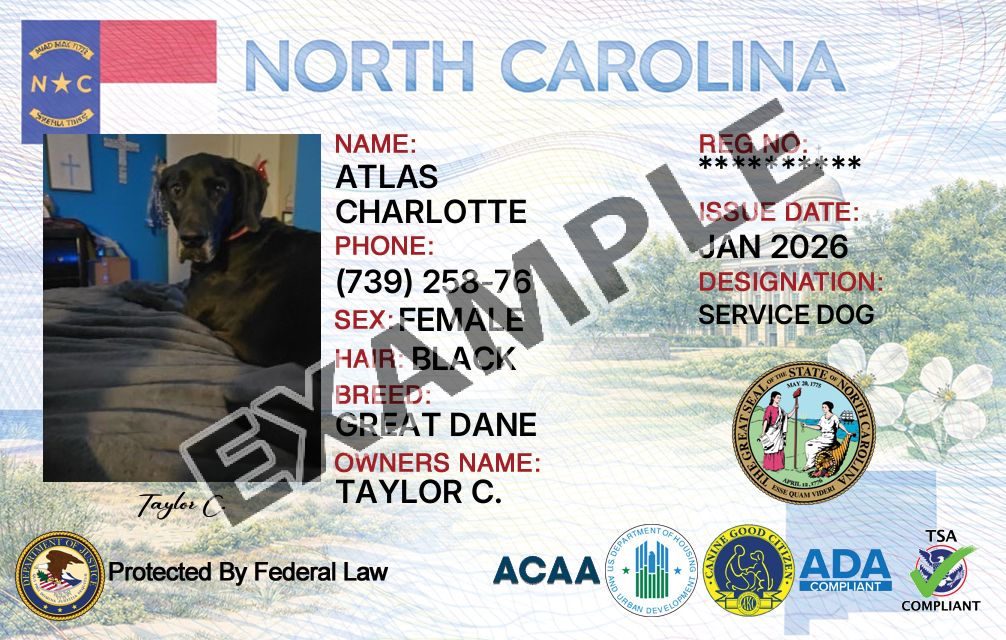
Service Dogs and Emotional Support Animals in Burke, North Carolina
If you’re asking, “where do I register my dog in Burke County, North Carolina for my service dog or emotional support dog?” the most important thing to know is this: dog registration (licensing/tagging) and service/ESA status are not the same process. In Burke County, dog-related enforcement and rabies compliance are handled through local government offices—primarily county animal services and, in some areas, city animal control.
This page explains how a dog license in Burke County, North Carolina typically works, what rabies documentation you may need, and what the law does (and does not) require for service dogs and emotional support animals.
Where to Register or License Your Dog in Burke County, North Carolina
Because licensing and enforcement can be handled at the county and/or city level, the right place to start depends on where you live in Burke County (for example, inside the City of Morganton limits versus outside city limits). The offices below are official, local government points of contact for animal control dog license Burke County, North Carolina questions, rabies compliance, and animal ordinances.
Official Offices (Examples Within Burke County)
| Office | Address | Phone | Hours | |
|---|---|---|---|---|
| Burke County Animal Services |
425 Kirksey Dr Morganton, NC 28655 |
(828) 764-9588 | AnimalServices@burkenc.org |
Tue 10:00am–7:00pm Wed 10:00am–4:00pm Thu 10:00am–7:00pm Fri 10:00am–4:00pm Sat 10:00am–4:00pm Sun–Mon Closed |
| Burke County Health Department (Public Health) |
700 E Parker Road Morganton, NC 28655 |
828-764-9150 | Not listed | Mon–Fri 8:00am–5:00pm |
| City of Morganton Animal Control (inside Morganton city limits) |
305 E. Union St., Suite A100 Morganton, NC 28655 |
(828) 437-8863 | Not listed | Not listed |
| Burke County Animal Control (outside Morganton city limits) |
Public Safety Center 304 S. College St. Morganton, NC 28655 |
828-764-9512 | Not listed | Records: Mon–Fri 8:00am–5:00pm |
Note: Some contact details (like general email addresses or published hours for certain city units) are not always listed publicly. If something is missing above, contact the office by phone to confirm the correct department for dog licensing or rabies tags.
Overview of Dog Licensing in Burke County, North Carolina
What “registering a dog” usually means
When people search where to register a dog in Burke County, North Carolina, they’re usually referring to one of these local compliance items:
- Rabies vaccination compliance (keeping your dog currently vaccinated and retaining proof).
- Rabies tag issuance (often provided by the vaccinating veterinarian; sometimes available through local animal services clinics).
- Local dog license or permit, if required by the jurisdiction where you live (county and/or city).
Who enforces rabies and animal ordinances
Rabies rules and animal ordinances are typically enforced through local animal control and public health channels. In Burke County, Burke County Animal Services is a key office for animal-related enforcement and community services, while the Burke County Health Department supports public health functions tied to rabies exposure and community health. If you live within a city’s limits (such as Morganton), you may also have a city animal control unit involved in enforcement or calls for service.
Bottom line for most residents
If you want the correct answer for your address, start by calling Burke County Animal Services and ask what is required for a dog license in Burke County, North Carolina at your residence (county area versus within a municipality), and what documentation they accept.
How Dog Licensing Works Locally in Burke County, North Carolina
Step 1: Confirm your jurisdiction (county vs. city limits)
Local animal rules can differ depending on where you live. The same street address can fall under county enforcement or municipal enforcement depending on city boundaries. That’s why “animal control dog license Burke County, North Carolina” searches can lead to different answers for different residents. If you’re unsure, tell the office your address and ask whether your area is served by county animal services, a city animal control unit, or both.
Step 2: Keep rabies vaccination current and keep proof
Even when a separate “dog license” is not issued, rabies vaccination compliance is central to dog ownership and public safety. Keep your dog’s rabies certificate (paper or digital) and ensure your dog wears appropriate tags when recommended by local rules. If you have a bite incident, stray pickup, or enforcement contact, proof of rabies vaccination is often the first document requested.
Step 3: Ask what “license” or tag is recognized locally
In many North Carolina communities, the rabies tag functions as the most common “proof” that a dog is current on rabies vaccination. Some places also have an additional city/county license tag or permit, while others do not. Because these programs can be updated, the most reliable approach is to call the official office and ask:
- Do you require an annual or multi-year dog license for my address?
- If yes, where do I apply and what documents do you need?
- Is the rabies tag sufficient, or is there a separate license tag?
- Are there different rules for dogs in city limits versus unincorporated areas?
Step 4: Understand fees and renewals
If a licensing fee applies, it’s usually tied to a time period (often annual) and may vary by factors like spay/neuter status or other local policy choices. Ask the office what the current fee schedule is and how renewals work so you don’t miss deadlines.
Service Dog Laws in Burke County, North Carolina
A service dog is not “licensed” by a registry
A service dog is defined by what the dog is trained to do for a person with a disability—not by a purchased certificate. Under U.S. disability law, a service dog generally must be individually trained to perform specific tasks related to a person’s disability. There typically is no government-run service dog “registration” you must complete to make the dog a service dog.
What businesses and landlords may ask
For public access in places like stores and restaurants, staff are typically limited to asking questions such as whether the dog is required because of a disability and what work or task the dog has been trained to perform (they generally cannot demand papers as proof in routine situations). For housing, different rules can apply, and documentation may be requested depending on the situation and the type of assistance animal (service dog versus ESA).
What you still must do locally
Even if your dog is a legitimate service dog, local requirements like rabies vaccination and any applicable local dog licensing rules still apply. In other words, service dog status does not automatically replace local compliance steps for public health and animal control.
Emotional Support Animal Rules in Burke County, North Carolina
An ESA is not the same as a service dog
An emotional support animal (ESA) provides comfort or emotional benefit, but an ESA is not the same as a service dog trained to perform disability-related tasks. That difference matters because ESAs generally do not have the same public access rights as service dogs in restaurants, grocery stores, or other public places.
Housing is usually where ESA documentation comes up
ESA requests most commonly arise in housing contexts. A housing provider may ask for information that supports your need for an assistance animal in housing, depending on the circumstances. This is separate from county “registration” and separate from rabies compliance.
Local licensing and rabies rules still apply
If you have an ESA in Burke County, you typically still need to keep your animal’s rabies vaccination current and follow any applicable local animal ordinances. If you’re unsure whether your area requires a separate license tag beyond rabies vaccination proof, call the official offices listed above.
Frequently Asked Questions
Usually, no government registration is required to make a dog a service dog. However, your dog may still need to meet local requirements such as rabies vaccination and any applicable local licensing rules. If you’re trying to determine the correct local compliance steps, start with Burke County Animal Services and ask what applies to your address.
If you live within the City of Morganton limits, you may interact with City of Morganton Animal Control for certain calls or enforcement. For countywide shelter and many animal services functions, Burke County Animal Services is a primary starting point.
Because rules can vary by location, the fastest way to confirm the correct office for where to register a dog in Burke County, North Carolina is to call and provide your address so the staff can route you correctly.
Not always. In many communities, a rabies tag is the most common proof that a dog is vaccinated, but some jurisdictions also issue a separate license or require additional steps. Ask your local office whether the rabies tag is sufficient or whether there is a separate dog license in Burke County, North Carolina for your area.
Burke County Animal Services has indicated that rabies vaccines may be available at their facility during business hours (with requirements such as identification). Call ahead to confirm availability, pricing, and what documentation you should bring.
Generally, no. ESAs are primarily a housing-related category, while service dogs are trained to perform specific tasks and may have broader access protections. Regardless of ESA or service dog status, you should still follow local rabies and animal ordinance requirements.
Register A Dog In Other North Carolina Counties
Select your county below to get started with your dog’s ID card. Requirements and license designs may vary by county, so choose your location to see the correct options and complete your pup’s registration.
- Alamance County Dog Registration
- Alexander County Dog Registration
- Alleghany County Dog Registration
- Anson County Dog Registration
- Ashe County Dog Registration
- Avery County Dog Registration
- Beaufort County Dog Registration
- Bertie County Dog Registration
- Bladen County Dog Registration
- Brunswick County Dog Registration
- Buncombe County Dog Registration
- Cabarrus County Dog Registration
- Caldwell County Dog Registration
- Camden County Dog Registration
- Carteret County Dog Registration
- Caswell County Dog Registration
- Catawba County Dog Registration
- Chatham County Dog Registration
- Cherokee County Dog Registration
- Chowan County Dog Registration
- Clay County Dog Registration
- Cleveland County Dog Registration
- Columbus County Dog Registration
- Craven County Dog Registration
- Cumberland County Dog Registration
- Currituck County Dog Registration
- Dare County Dog Registration
- Davidson County Dog Registration
- Davie County Dog Registration
- Duplin County Dog Registration
- Edgecombe County Dog Registration
- Forsyth County Dog Registration
- Franklin County Dog Registration
- Gaston County Dog Registration
- Gates County Dog Registration
- Graham County Dog Registration
- Granville County Dog Registration
- Greene County Dog Registration
- Guilford County Dog Registration
- Halifax County Dog Registration
- Harnett County Dog Registration
- Haywood County Dog Registration
- Henderson County Dog Registration
- Hertford County Dog Registration
- Hoke County Dog Registration
- Hyde County Dog Registration
- Iredell County Dog Registration
- Jackson County Dog Registration
- Johnston County Dog Registration
- Jones County Dog Registration
- Lee County Dog Registration
- Lenoir County Dog Registration
- Lincoln County Dog Registration
- Macon County Dog Registration
- Madison County Dog Registration
- Martin County Dog Registration
- McDowell County Dog Registration
- Mecklenburg County Dog Registration
- Mitchell County Dog Registration
- Montgomery County Dog Registration
- Moore County Dog Registration
- Nash County Dog Registration
- New Hanover County Dog Registration
- Northampton County Dog Registration
- Onslow County Dog Registration
- Orange County Dog Registration
- Pamlico County Dog Registration
- Pasquotank County Dog Registration
- Pender County Dog Registration
- Perquimans County Dog Registration
- Person County Dog Registration
- Pitt County Dog Registration
- Polk County Dog Registration
- Randolph County Dog Registration
- Richmond County Dog Registration
- Robeson County Dog Registration
- Rockingham County Dog Registration
- Rowan County Dog Registration
- Rutherford County Dog Registration
- Sampson County Dog Registration
- Scotland County Dog Registration
- Stanly County Dog Registration
- Stokes County Dog Registration
- Surry County Dog Registration
- Swain County Dog Registration
- Transylvania County Dog Registration
- Tyrrell County Dog Registration
- Union County Dog Registration
- Vance County Dog Registration
- Wake County Dog Registration
- Warren County Dog Registration
- Washington County Dog Registration
- Watauga County Dog Registration
- Wayne County Dog Registration
- Wilkes County Dog Registration
- Wilson County Dog Registration
- Yadkin County Dog Registration
- Yancey County Dog Registration